 28 Jul 2026
Most small businesses and professionals in India do not need to keep audited books at all. The Income-tax Act lets you declare a fixed percentage of turnover as profit, pay tax on that, and skip the bookkeeping and the audit entirely. That is the presumptive taxation scheme, and for owner-run businesses it is one of the most useful and most misunderstood provisions in the Act.
The catch is that the scheme has hard thresholds and one trap that quietly forces people back into a full audit. This guide sets out the current position for AY 2026-27 (FY 2025-26) across Sections 44AD, 44ADA and 44AE, the rates, the limits, and the mistakes that cost people the benefit.
What is presumptive taxation? (Quick answer)
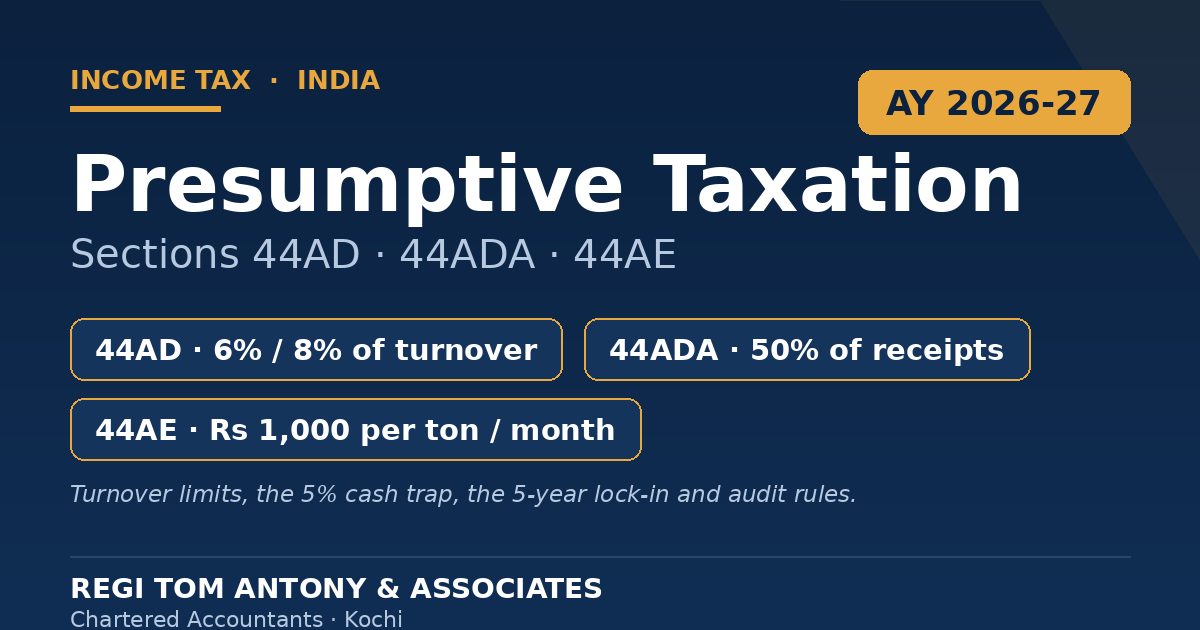
Presumptive taxation lets eligible small businesses and professionals declare income at a fixed rate of turnover instead of maintaining books and undergoing audit. Businesses use Section 44AD (6% of digital and 8% of cash turnover, up to Rs 3 crore), professionals use Section 44ADA (50% of receipts, up to Rs 75 lakh), and goods-carriage operators use Section 44AE. You pay advance tax in one instalment by 15 March and file ITR-4.
General guidance for AY 2026-27, not individual tax advice. Confirm your own position with a CA before filing.
The three schemes at a glance
| Section | Who it is for | Limit (AY 2026-27) | Deemed income |
|---|---|---|---|
| 44AD | Resident individual, HUF or partnership firm (not LLP) in eligible business | Rs 2 crore, or Rs 3 crore if cash receipts are 5% or less of turnover | 6% of digital turnover, 8% of cash turnover |
| 44ADA | Resident professionals (legal, medical, engineering, architecture, accountancy, technical consultancy, interior design and other notified professions) | Rs 50 lakh, or Rs 75 lakh if cash receipts are 5% or less | 50% of gross receipts |
| 44AE | Goods-carriage operators owning up to 10 vehicles | No turnover limit (per-vehicle basis) | Rs 1,000 per ton per month for a heavy vehicle; Rs 7,500 per month for others |
Section 44AD, for small businesses
The workhorse of the scheme, and the one most owner-run businesses qualify for.
A resident individual, HUF or partnership firm (an LLP cannot use it) carrying on an eligible business can declare 6% of digital turnover and 8% of cash turnover as income. The eligibility limit is turnover of Rs 2 crore, extended to Rs 3 crore where cash receipts are 5% or less of total turnover, which most digital-first businesses easily meet. Once you declare under 44AD, you cannot separately deduct business expenses, depreciation, or (since 2016) partners' remuneration and interest, because the flat rate is deemed to be net of everything.
The 6% versus 8% split is a real incentive to go digital. A retailer with Rs 1.8 crore turnover that is 95% digital declares 6% on the Rs 1.71 crore digital plus 8% on the Rs 9 lakh cash, roughly Rs 10.98 lakh, rather than 8% on the whole. On a fully cash business the same turnover would deem Rs 14.4 lakh.
Section 44ADA, for professionals
Built for solo professionals, and often over-used by people whose real margin is below 50%.
A resident professional in a specified field (legal, medical, engineering, architectural, accountancy, technical consultancy, interior decoration, and other notified professions such as IT and authorised representation) can declare 50% of gross receipts as income. The limit is Rs 50 lakh, extended to Rs 75 lakh where cash receipts are 5% or less. It is genuinely simple, but it is not always the cheaper answer. A consultant with Rs 40 lakh of receipts declares Rs 20 lakh under 44ADA regardless of actual costs. If real margins run above 50%, the scheme saves tax; if they run below 50%, regular books with actual expenses produce a lower figure. Run both numbers before you opt in.
Section 44AE, for goods carriage
A per-vehicle scheme for transporters with a small fleet.
An operator owning up to 10 goods vehicles declares Rs 1,000 per ton of gross vehicle weight per month for each heavy vehicle (above 12 tonnes) and Rs 7,500 per month for each other vehicle, with no turnover threshold. It suits small transport operators who would otherwise struggle to keep vehicle-level accounts.
The 5% cash trap
This is where people lose the benefit without realising it.
The enhanced limits, Rs 3 crore for 44AD and Rs 75 lakh for 44ADA, apply only if cash receipts stay at 5% or less of total receipts. Cross that line by even a fraction and you drop back to the Rs 2 crore or Rs 50 lakh limit, and if your turnover is above the lower limit you are pushed into regular assessment with a tax audit. Cheque and bank-clearing receipts count toward the digital side, but track the cash ratio through the year rather than discovering it at filing.
The 5-year lock-in under Section 44AD(4)
Opting in and out at will is not allowed, and the exit is expensive.
If you declare under 44AD and then opt out in a later year, you are barred from the scheme for the next five assessment years. During that period, if your income exceeds the basic exemption limit, you must maintain books and get a tax audit under Section 44AB. So 44AD is a commitment, not a year-by-year toggle. Decide deliberately, because leaving triggers exactly the audit obligation the scheme was meant to avoid.
When a tax audit still applies
Presumptive taxation removes the audit for those who stay inside it, but an audit under Section 44AB is still triggered if you opt out within the five-year bar and your income exceeds the basic exemption limit, or if you exceed the turnover or receipts limit and choose to keep regular books. The interaction between the presumptive sections and the audit thresholds is where most errors happen, and it is set out in full in our tax audit under Section 44AB guide for AY 2026-27.
Advance tax and filing
Presumptive taxpayers get one real simplification on payment: advance tax is due in a single instalment by 15 March, not the usual four dates, and paying it in full by then avoids interest under Section 234C. The return is filed on ITR-4 (Sugam) with the deemed profit figure. That single-instalment relief is one of the quieter advantages of the scheme and worth planning cash flow around.
The bottom line
Presumptive taxation is one of the few genuinely simplifying provisions in Indian tax, but only if you fit it deliberately. Confirm you are under the turnover or receipts limit, keep cash receipts at or below 5% to hold the enhanced limit, run the 44ADA 50% figure against your real margins before opting in, and remember that 44AD is a five-year commitment. Get those four right and you trade a full audit for a single advance-tax payment and a one-page return. Get the cash ratio or the lock-in wrong and you land in exactly the audit you were trying to avoid, which is why a short check with a CA before you opt in usually pays for itself.
Frequently asked questions
What is the turnover limit for Section 44AD in AY 2026-27?
The limit is Rs 2 crore, extended to Rs 3 crore where cash receipts are 5% or less of total turnover. Above Rs 3 crore, or above Rs 2 crore with more than 5% cash, you cannot use 44AD and normal provisions apply. The scheme is open to resident individuals, HUFs and partnership firms, but not to LLPs.
What is the presumptive rate under Section 44AD?
Income is deemed at 8% of turnover received in cash and 6% of turnover received digitally (bank transfer, cheque, card or UPI). The lower 6% rate is a deliberate incentive to accept digital payments. No further deduction for expenses, depreciation or partners' remuneration is allowed on top of the deemed figure.
Who can use Section 44ADA and what is the limit?
Resident professionals in specified fields such as legal, medical, engineering, architecture, accountancy, technical consultancy and interior decoration. The limit is Rs 50 lakh gross receipts, extended to Rs 75 lakh where cash receipts are 5% or less. They declare 50% of gross receipts as income and pay tax on that.
Is presumptive taxation always cheaper for professionals?
No. Section 44ADA deems income at 50% of receipts regardless of actual costs. If your real profit margin is above 50%, the scheme saves tax; if it is below 50%, maintaining regular books and claiming actual expenses produces a lower taxable figure. Run both before opting in.
What is the 5-year rule under Section 44AD?
If you opt into 44AD and later opt out, you are barred from the scheme for the next five assessment years. In those years, if your income exceeds the basic exemption limit, you must keep books and undergo a tax audit under Section 44AB. It makes 44AD a multi-year commitment rather than a year-by-year choice.
How is advance tax paid under presumptive taxation?
In a single instalment by 15 March of the financial year, instead of the four instalments normal taxpayers pay. Paying the full liability by that date avoids interest under Section 234C. The return is filed on ITR-4 (Sugam) with the deemed profit.