 19 Jul 2026
Every year we meet NRIs who timed their India visit around the well-known 182-day rule — and still ended up a tax resident. The reason is a second, less-discussed test that catches higher-income returnees at just 120 days.
The two basic tests under Section 6
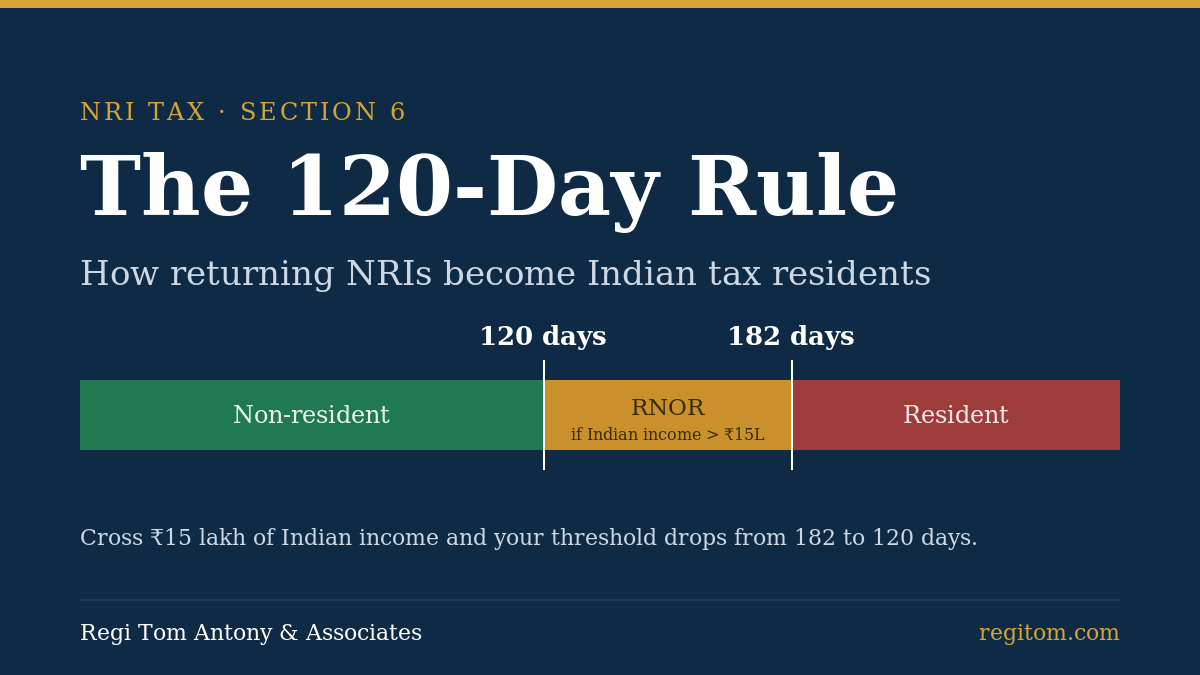
Under Section 6 of the Income-tax Act, you are a Resident of India in a financial year if you are in India for 182 days or more. But there is a second limb: 60 days in the year combined with 365 days across the previous four years. For most visiting NRIs that 60-day limb is relaxed to 182 days — unless your Indian-source income (income other than foreign-source) exceeds ₹15 lakh in the year. Cross that ₹15 lakh line, and the threshold drops to 120 days.
Why 120 days becomes the real line for higher earners
The saving grace is that anyone caught only by this 120-day rule is classified RNOR — Resident but Not Ordinarily Resident — not an ordinary resident. An RNOR is taxed on Indian income and only on foreign income derived from a business controlled in, or a profession set up in, India. Ordinary foreign salary, pensions and investment income stay outside the Indian net. For someone returning to India for good, this RNOR window typically covers the first two to three years — and sequencing large foreign disposals into it can save a very large tax bill.
Two practical points for every returning NRI
- Count arrival and departure days — both count as days in India, and a short year-end trip can push a borderline case over the line.
- Know your Indian-income number before you book long visits — crossing ₹15 lakh quietly moves your relevant threshold from 182 days to 120.
Where to go deeper
We have built a detailed, plain-English resource on this for NRIs. For the full mechanics — including deemed residency under Section 6(1A) and the RNOR tests — see NRI residential status & Section 6 on our dedicated NRI platform, NRI Blueprint. If double taxation is your concern once you are resident, the companion guide on DTAA relief for NRIs covers the credit-vs-exemption mechanics and the Form 67 / TRC paperwork.
Not sure which side of the line you fall on? Run the free RNOR calculator — it applies all of the Section 6 tests in under a minute.
Frequently asked questions
How many days can an NRI stay in India without becoming a resident?
An Indian citizen or PIO visiting India whose Indian income (other than foreign-source) is ₹15 lakh or less can stay up to 181 days in a financial year and remain non-resident. If Indian income exceeds ₹15 lakh, the safe limit drops to 119 days — 120 days or more, combined with 365+ days over the prior four years, makes you Resident and RNOR.
What is the 120-day rule for NRIs?
An Indian citizen or PIO visiting India whose total income other than foreign-source income exceeds ₹15 lakh becomes Resident if present 120 days or more in the year and 365 days or more across the preceding four years. Anyone caught only by this rule is classified RNOR, so foreign income stays outside Indian tax.
What is deemed residency under Section 6(1A)?
An Indian citizen with Indian income above ₹15 lakh who is not liable to tax in any other country by reason of domicile or residence is deemed Resident regardless of day-count, and is classified RNOR. UAE or Bahrain residents holding a valid Tax Residency Certificate are generally not caught.
Is foreign income taxed for an RNOR?
No, with one exception. An RNOR is taxed on all Indian income and on foreign income only if it is derived from a business controlled in, or a profession set up in, India. Ordinary foreign salary, pension and investment income are outside the Indian net during the RNOR years.
How long does RNOR status last?
For a returning NRI who has been non-resident for many years, RNOR typically covers the first two to three financial years after return; landing in the second half of a financial year usually extends it to a full three-year window.
This is general information, not individual tax advice. Confirm your own day-count and income position before acting.
Dedicated NRI guidance
Try our free RNOR calculator for checking your residential status and RNOR window on NRIBlueprint.com — our dedicated NRI tax & advisory site — or contact Regi Tom Antony & Associates for personalised help.