 Published
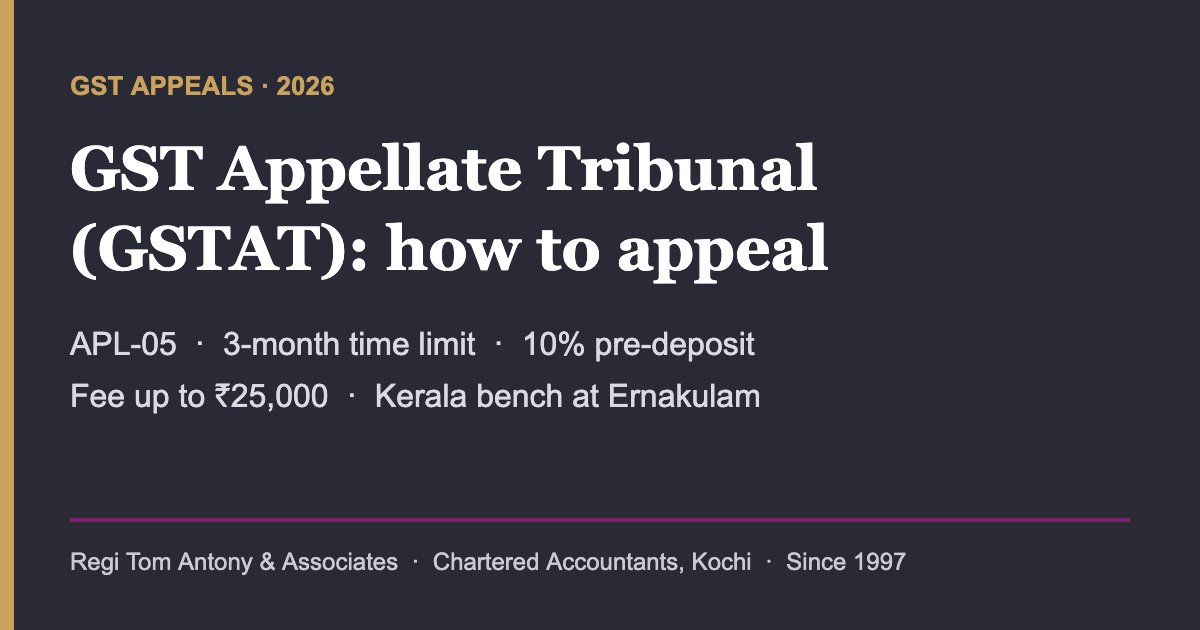
Quick answer — appealing to GSTAT in 2026:
| Point | Position |
|---|---|
| What GSTAT hears | Second appeals against orders of the Appellate Authority (section 107) or Revisional Authority (section 108) under the CGST Act |
| Time limit | 3 months from communication of the order for taxpayers (6 months for the department); up to 3 more months on sufficient cause |
| Pre-deposit | Admitted tax + 10% of the tax still in dispute (on top of the 10% paid at first appeal), capped at ₹20 crore |
| Fee | ₹1,000 per ₹1 lakh in dispute, maximum ₹25,000 |
| Form and filing | APL-05, filed online on the GSTAT e-filing portal |
| Kerala bench | Ernakulam (Kochi), with sittings at Thiruvananthapuram |
For eight years a GST demand upheld by the first appellate authority had nowhere to go except the High Court in writ. The GST Appellate Tribunal changes that. It was launched on 24 September 2025, the backlog of old appellate orders had to be filed by 31 July 2026, and every new first-appeal order now has a normal three-month window to the Tribunal. This guide sets out who can appeal, when, what it costs and what to check before filing.
What GSTAT is
The GST Appellate Tribunal (GSTAT) is constituted under section 109 of the CGST Act, 2017. It has a Principal Bench in New Delhi and State Benches across the country. Each bench has judicial and technical members. The Principal Bench hears disputes where place of supply is one of the issues; State Benches hear the rest.
For Kerala, the State Bench sits at Ernakulam (Kochi), with sittings at Thiruvananthapuram. That matters for businesses here: hearings are local, and representation does not mean travelling to Bengaluru or Chennai.
Which orders can be appealed to GSTAT
- An order of the Appellate Authority under section 107 (your first appeal in Form APL-01 was decided against you, fully or partly).
- An order of the Revisional Authority under section 108.
GSTAT is not a first appeal. An order raising a demand under section 73, 74 or 74A goes first to the Appellate Authority in APL-01 within three months. The Tribunal may also refuse to admit an appeal where the amount in dispute is ₹50,000 or less (section 112(2)).
Time limits
| Who / what | Time limit | Law |
|---|---|---|
| Taxpayer appeal (APL-05) | 3 months from the date the order is communicated | Section 112(1) |
| Department application (APL-07) | 6 months from the date of the order | Section 112(3) |
| Late filing | Up to 3 more months, if the Tribunal accepts the cause shown | Section 112(6) |
| Cross-objections (APL-06) | 45 days from receipt of notice of the other side's appeal | Section 112(5) |
| Older orders (transitional) | Orders communicated before 1 May 2026 could be appealed up to 31 July 2026 | Notification under section 112(1) and 112(3), 30 June 2026 |
The transitional window has closed. For any order communicated from 1 May 2026, the ordinary three-month limit applies, and it runs from the date the order is communicated, usually the date it is uploaded on the GST portal.
Pre-deposit
Before the appeal is admitted you must pay (section 112(8)):
- the full amount of tax, interest, fine, fee and penalty that you admit; and
- 10% of the tax still in dispute, in addition to the 10% paid at the first appeal under section 107(6), subject to a maximum of ₹20 crore.
Where the order is for penalty only, the pre-deposit is 10% of the penalty (Finance Act, 2025). Once the pre-deposit is paid, recovery of the balance is stayed until the appeal is decided (section 112(9)). The pre-deposit is refunded with interest if you win.
Appeal fee
₹1,000 for every ₹1 lakh of tax, input tax credit, fine, fee or penalty involved, subject to a maximum of ₹25,000 (rule 110(5), CGST Rules). There is no fee for an application to rectify a mistake apparent on the record.
How to file: step by step
- Check the order and the date it was communicated. Work out the last date and whether any part of the demand is covered by the section 128A waiver.
- Decide what to contest. Points you accept are paid; the appeal is limited to the disputed amount, which also limits the pre-deposit.
- Pay the pre-deposit on the GST portal and keep the payment reference.
- Prepare Form APL-05: statement of facts, grounds of appeal, the order appealed against, the first-appeal order and the documents relied on.
- File on the GSTAT e-filing portal under the GSTAT (Procedure) Rules, 2025, pay the fee and note the acknowledgement.
- Attend the hearing. A Chartered Accountant, advocate, Cost Accountant or Company Secretary can appear as your authorised representative (section 116).
What to check before you appeal
- Limitation of the original notice. Was the show cause notice issued within the time allowed under section 73, 74 or 74A for that year? A time-barred notice is often the strongest ground.
- Findings of fact. GSTAT is the last forum that decides facts. After it, the High Court hears only substantial questions of law (section 117). Put every document and reconciliation before the Tribunal.
- Cash flow. A further 10% pre-deposit on a large demand needs planning; the cap is ₹20 crore.
- Interest. Interest under section 50 keeps running on any tax finally upheld. Paying an admitted part early reduces it.
Where GSTAT fits in the GST dispute route
Scrutiny (ASMT-10) or audit (ADT-02) → show cause notice (DRC-01) → order (DRC-07) → first appeal (APL-01, section 107) → GSTAT (APL-05, section 112) → High Court (section 117, law only) → Supreme Court. Most disputes are decided, or avoided, at the first two stages, which is why the reply to a scrutiny notice or audit observation matters as much as the appeal. The full route is set out on our GST audit and assessment services page.
Need help with this? We prepare and argue GST appeals before the Appellate Authority and the GST Appellate Tribunal, and handle the audit, scrutiny and show cause stages before them. See GST audit and assessment services in Kochi or book a 15-minute GST review call.
Frequently asked questions
What is GSTAT?
GSTAT is the GST Appellate Tribunal constituted under section 109 of the CGST Act, 2017. It hears second appeals against orders of the Appellate Authority (section 107) and the Revisional Authority (section 108). It was formally launched on 24 September 2025, with a Principal Bench in New Delhi and State Benches across the country.
What is the time limit to file an appeal before GSTAT?
A taxpayer must appeal within three months of the date the order is communicated (section 112(1)); the department has six months (section 112(3)). The Tribunal can admit an appeal up to three months late if there was sufficient cause (section 112(6)). For older orders communicated before 1 May 2026, the Government allowed filing up to 31 July 2026.
How much pre-deposit is required for a GSTAT appeal?
The admitted tax in full, plus 10% of the tax still in dispute, in addition to the 10% already paid at the first appeal, subject to a cap of ₹20 crore (section 112(8)). For appeals against penalty-only orders, the pre-deposit is 10% of the penalty. Once the pre-deposit is paid, recovery of the balance is stayed until the appeal is decided (section 112(9)).
What is the fee for a GSTAT appeal?
₹1,000 for every ₹1 lakh of tax, input tax credit, fine, fee or penalty involved, up to a maximum of ₹25,000 (rule 110(5) of the CGST Rules).
Which form is used to appeal to GSTAT?
Form GST APL-05 for the appeal and APL-06 for cross-objections; the department files its application in APL-07. Under the GSTAT (Procedure) Rules, 2025, appeals are filed electronically on the GSTAT e-filing portal.
Where is the GSTAT bench for Kerala?
The State Bench for Kerala sits at Ernakulam (Kochi), with sittings at Thiruvananthapuram, under the Government notification constituting the State Benches as amended on 26 November 2024.
Can GSTAT refuse to hear an appeal?
Yes. The Tribunal may refuse to admit an appeal where the tax, input tax credit, fine, fee or penalty in dispute is ₹50,000 or less (section 112(2)).
Can a Chartered Accountant appear before GSTAT?
Yes. Section 116 allows a Chartered Accountant, advocate, Cost Accountant or Company Secretary to appear as an authorised representative.
What can I do if I missed the GSTAT deadline?
Check whether the delay is within the three months the Tribunal can condone under section 112(6), and file with an application explaining the cause. Beyond that, the remedy usually lies only before the High Court in writ, which is narrow and slow.
Can I go to the High Court after GSTAT?
An appeal to the High Court lies under section 117 only on a substantial question of law, within 180 days of the State Bench order. Appeals against Principal Bench orders on place of supply go to the Supreme Court (section 118).
Related guides
- GST audit and assessment services: GSTR-9C, section 65 and 66 audits, notices and appeals
- Section 128A GST waiver of interest and penalty: what still applies in 2026
- How to handle GST and income-tax notices
- Input tax credit under GST: conditions and the 30 November 2026 deadline
Sources
- Central Goods and Services Tax Act, 2017, sections 107, 109, 112, 116 and 117; CGST Rules, 2017, rule 110 — CBIC GST
- GST Appellate Tribunal — gstat.gov.in
This guide reflects the law as at 11 November 2026. It is general information, not advice on a specific case.