 2 Jun 2026
Most NRIs I speak with assume property tax in India works the same way it did when they lived here. It doesn't — and the difference can cost you significantly if you're not prepared.
Updated: 23 October 2026 | Regi Tom Antony & Associates, Chartered Accountants, Kochi
NRI property sale: the rules that apply in 2026-27
| Item | Position |
|---|---|
| Long-term capital gains (held over 24 months) | 12.5% without indexation, whatever the purchase date. The option of 20% with indexation for land or buildings bought before 23 July 2024 is available only to resident individuals and HUFs, not to NRIs. |
| Surcharge | 10% where total income exceeds ₹50 lakh and 15% above ₹1 crore; capped at 15% on capital gains. Plus 4% cess. |
| Maximum effective rate on long-term gains | 14.95% (12.5% + 15% surcharge + 4% cess) |
| TDS by the buyer | Section 195 (section 393 of the Income-tax Act, 2025 for payments from 1 April 2026). The buyer files Form 27Q and issues Form 16A, not Form 26QB / 16B. |
| Buyer's TAN | Budget 2026 removes the TAN requirement: from 1 October 2026 the buyer can deposit TDS through a PAN-based challan. |
| Lower TDS certificate | Form 128 on the TRACES portal under section 395 (Form 13 under section 197 until 31 March 2026). |
| Repatriation | Up to USD 1 million per financial year from the NRO account, with Form 145 and, where required, the CA's Form 146 (Forms 15CA / 15CB until 31 March 2026). |
If you're an NRI selling immovable property in India, capital gains tax applies at rates that differ from resident Indians, and the TDS mechanism means the buyer deducts tax upfront before you even receive the sale consideration. Here's how it works in practice.
Short-Term vs Long-Term: The Starting Point
The holding period determines everything. If you've held the property for more than 24 months, the gain is long-term (LTCG). Under 24 months, it's short-term (STCG).
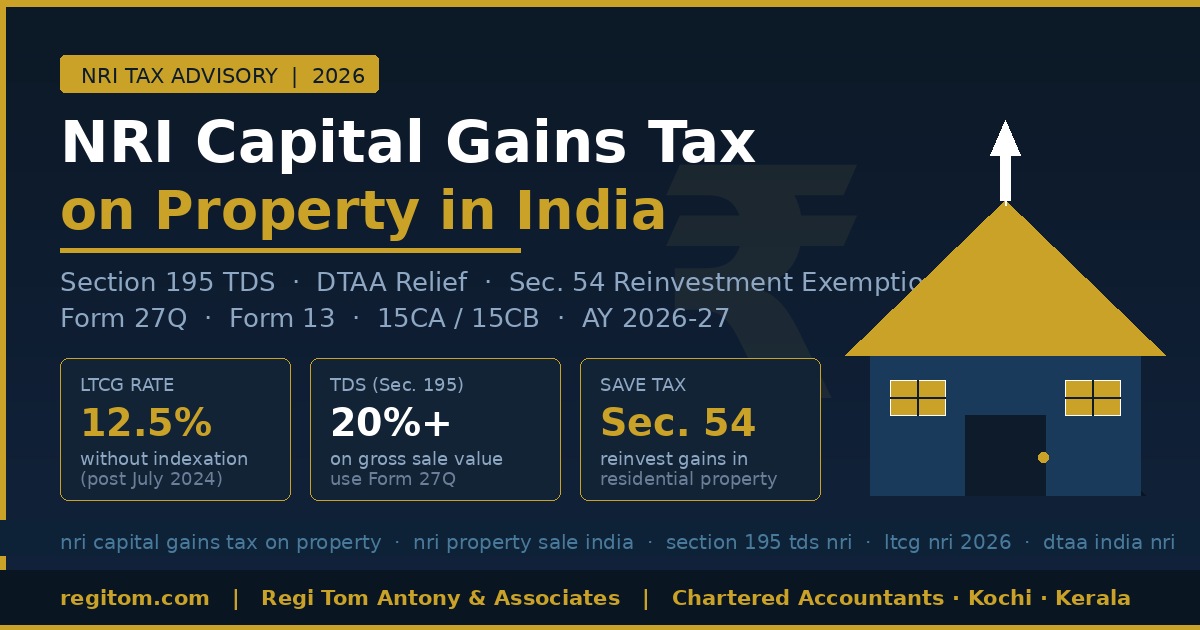
For NRIs, LTCG on property is taxed at 12.5% without indexation benefit (post-Budget 2024, effective 23 July 2024). The older option of 20% with indexation for property bought before 23 July 2024 is available only to resident individuals and HUFs; NRIs pay 12.5% without indexation whatever the date of purchase. Surcharge on capital gains is capped at 15%, so the maximum effective rate on LTCG is 14.95%.
TDS: The Buyer's Obligation Under Section 195
When anyone buys property from an NRI, they must deduct TDS under Section 195 of the Income-tax Act, 1961 (section 393 of the Income-tax Act, 2025 from 1 April 2026). On long-term gains the rate is 12.5% plus surcharge (capped at 15%) and 4% cess, an effective rate of up to 14.95%. On short-term gains it is the slab rate plus surcharge and cess.
The critical issue: TDS is deducted on the gross sale consideration, not on the net gain. If you purchased the property for Rs 60 lakhs and are selling for Rs 1 crore, the buyer deducts TDS on Rs 1 crore — not on the Rs 40 lakh gain. This almost always results in excess TDS that you must recover as an ITR refund.
For payments up to 30 September 2026 the buyer deposits this TDS under a TAN and reports it in Form 27Q, not Form 26QB (which applies only where the seller is resident). From 1 October 2026, buyers of property from NRIs can pay the TDS through a PAN-based challan without a TAN. This distinction is frequently missed by buyers and their advisers.
How to Reduce TDS: Lower Deduction Certificate (Form 128, Section 395; formerly Section 197 and Form 13)
If the TDS deductible under Section 195 exceeds your actual tax liability — which it almost always does — you can apply to the Jurisdictional Assessing Officer (JAO) for a lower or nil TDS certificate under section 395 (formerly section 197).
From 1 April 2026 the application is made in Form 128 on the TRACES portal under section 395 of the Income-tax Act, 2025 (it was Form 13 under section 197 before). The Assessing Officer reviews your capital gains computation and issues a certificate specifying a reduced or nil rate. Give the certificate to the buyer before the payment is made.
DTAA Relief: When Your Country of Residence Matters
India has Double Taxation Avoidance Agreements (DTAAs) with over 90 countries. Depending on your country of tax residence, a DTAA may provide a credit mechanism or preferential treatment on capital gains.
- UAE residents: The India-UAE DTAA does not exempt capital gains on Indian immovable property. India retains full taxing rights. The DTAA prevents UAE from taxing it too — but since UAE has no personal income tax, this rarely provides practical benefit.
- US residents: The India-US DTAA provides a Foreign Tax Credit mechanism. You report the Indian gain to the IRS and claim credit for Indian taxes paid against your US liability.
- UK residents: Similar FTC mechanism. Pay Indian CGT first, claim credit in the UK against Capital Gains Tax liability there.
To claim DTAA benefit in India, you must furnish a Tax Residency Certificate (TRC) from your country of residence and file Form 10F on the Indian income tax portal. Without both documents, the Indian tax authority will not grant treaty relief.
Reinvestment Exemptions Available to NRIs
NRIs can claim the same capital gains exemptions available to resident Indians:
- Section 54: Exemption on LTCG from residential property if reinvested in another residential property in India within 2 years of sale (or 3 years for under-construction property). Cap: Rs 10 crore from AY 2024-25.
- Section 54EC: Invest up to Rs 50 lakhs in specified bonds (NHAI, REC, PFC or IRFC) within 6 months of the sale date. Lock-in is 5 years.
- Section 54F: For LTCG from sale of assets other than residential property. The full net sale consideration must be reinvested in a residential property.
If reinvestment is not completed before the ITR filing deadline, the gains can be deposited in a Capital Gains Account Scheme (CGAS) account with a designated bank to preserve the exemption eligibility.
Repatriation of Sale Proceeds
After taxes are settled, you can repatriate net sale proceeds from your NRO account. Under FEMA, repatriation is permitted up to USD 1 million per financial year per NRI from the NRO account after payment of applicable taxes.
Your bank will require Form 145 (the remitter's declaration, which replaced Form 15CA from 1 April 2026) and, where required, Form 146 (the CA's certificate, which replaced Form 15CB) before processing the outward remittance. The CA certificate confirms that the applicable taxes have been paid or that the remittance is not taxable. Without these, the bank will not process the transfer.
Filing the Income Tax Return
Capital gains must be reported in ITR-2 (where the NRI has no business income) or ITR-3. The due date for non-audit cases is 31 July of the assessment year.
Capital gains must be reported in ITR-2 (where the NRI has no business income) or ITR-3. The due date for non-audit cases is 31 July after the end of the year. The basic exemption limit is ₹4 lakh under the new regime (from FY 2025-26) and ₹2.5 lakh under the old regime. NRIs cannot use any unused basic exemption limit against long-term capital gains, and the enhanced exemption for senior citizens does not apply to NRIs.
Common Mistakes NRIs Should Avoid
- Accepting Form 26QB instead of Form 27Q from the buyer — these are for different types of transactions (for payments up to 30 September 2026; a PAN-based challan applies from 1 October 2026)
- Not applying for a lower deduction certificate (Form 128) in advance — leads to excess TDS deduction and months of delayed refund
- Missing the Section 54 reinvestment window — it runs from the date of transfer, not registration
- Assuming DTAA is automatic — you need TRC + Form 10F filed with the Indian tax authority
- Forgetting Forms 145/146 (formerly 15CA/15CB) before repatriation — the bank will block the transfer
NRI property transactions require coordination between the buyer's CA, your CA, and your bank. Getting one piece wrong creates a cascade of compliance issues. If you're planning a property sale in India in 2026, engage your CA at least 60-90 days before the transaction — not after the sale deed is signed.
For personalised advice on your NRI property tax position, contact Regi Tom Antony & Associates, Chartered Accountants, Kochi.
Frequently Asked Questions — NRI Capital Gains Tax on Property in India
What is the capital gains tax rate for NRIs selling property in India in 2026?
For long-term capital gains (property held more than 24 months), the tax rate for NRIs is 12.5% without indexation, effective from 23 July 2024 (post-Budget 2024). For short-term capital gains (held 24 months or less), the gain is taxed at the applicable income tax slab rate. Both rates are subject to surcharge and 4% Health and Education Cess.
What TDS rate does the buyer deduct when purchasing property from an NRI?
The buyer deducts TDS under Section 195 (section 393 of the Income-tax Act, 2025 from 1 April 2026). On long-term gains the rate is 12.5% plus surcharge (capped at 15%) and cess, a maximum effective rate of 14.95%, and in practice it is applied to the full sale consideration unless the seller has a lower deduction certificate. Up to 30 September 2026 the buyer uses a TAN and Form 27Q; from 1 October 2026 a PAN-based challan can be used.
How can an NRI reduce or avoid excess TDS on a property sale?
An NRI can apply for a lower or nil deduction certificate in Form 128 on the TRACES portal under section 395 of the Income-tax Act, 2025 (formerly Form 13 under section 197). The Assessing Officer reviews the actual capital gains computation and issues a certificate at a reduced rate, which the NRI gives to the buyer before the payment. Allow 15–30 days, so start well before the sale.
Can NRIs claim exemption from capital gains tax by reinvesting the sale proceeds?
Yes. NRIs can claim capital gains exemption under Section 54 (reinvest in another residential property within 2–3 years), Section 54EC (invest up to Rs 50 lakhs in NHAI/REC bonds within 6 months), or Section 54F (for sale of non-residential assets with full net consideration reinvested). If reinvestment is not completed before the ITR filing deadline, proceeds can be parked in a Capital Gains Account Scheme (CGAS) account.
Can NRIs repatriate the money received from selling property in India?
Yes. After paying all applicable taxes, NRIs can repatriate up to USD 1 million per financial year from their NRO account under FEMA. The bank requires Form 145 and, where applicable, the CA's certificate in Form 146 (these replaced Forms 15CA and 15CB from 1 April 2026). Property bought with NRE or FCNR funds has additional repatriation provisions.
Do NRIs need to file an income tax return in India after selling property?
Yes. Capital gains from the sale of Indian property must be reported in ITR-2 (or ITR-3 if there is business income). Filing is mandatory if total income exceeds the basic exemption limit (₹4 lakh under the new regime, ₹2.5 lakh under the old regime). Even if TDS covers the full liability, filing is the only way to claim a refund of excess TDS, carry forward a capital loss and keep a compliance record.
NRIs selling or repatriating property and inheritance: see Repatriating inherited assets and property sale proceeds from India on NRI Blueprint.
Dedicated NRI guidance
For an in-depth, up-to-date guide on our dedicated NRI tax & advisory guidance, visit NRIBlueprint.com — our dedicated NRI tax & advisory site — or contact Regi Tom Antony & Associates for personalised help.